
Adapting Care to the Person: Why Evaluation Changes Everything
Jun 02, 2026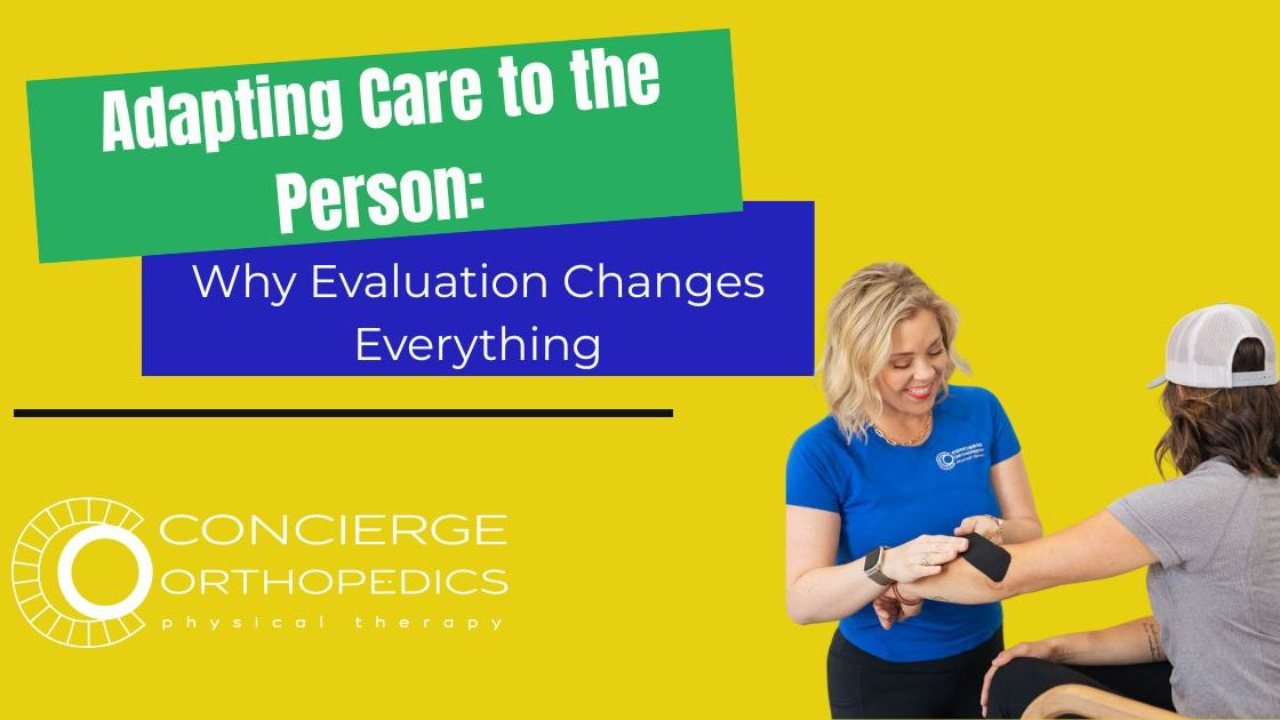
Adapting Care to the Person: Why Evaluation Changes Everything
Adapting Care Starts Before Treatment Ever Begins
One of the most important shifts in physical therapy is understanding that no two patients require the same plan of care—even when the diagnosis looks similar on paper.
The real difference is not found in the injury itself, but in how the body moves, adapts, and compensates under load. That is why effective care does not begin with treatment. It begins with evaluation, and more importantly, with interpretation.
At its core, adapting care to the person means recognizing that the body is always telling a broader story than the symptom that brought someone in.
When the Body Is Saying Something Different Than the Pain
A patient came in to see Dr. Shania Grode for persistent discomfort during upper body activity. The expectation at the start of the visit was straightforward—identify the irritated area, reduce symptoms, and rebuild tolerance to movement.
But as movement was assessed, the picture began to shift.
What was initially assumed to be a localized issue turned out to be a load distribution problem across the movement system. One region of the body was consistently compensating for another area that was not contributing efficiently, forcing certain structures to absorb more demand than they were designed to handle.
This is where evaluation becomes more than observation. It becomes provider decision-making in real time.
Because once the movement was fully understood, it became clear that treating only the area of discomfort would not resolve the underlying pattern driving the symptoms.
Why the Plan of Care Had to Change
Instead of narrowing the focus to the painful area alone, Dr. Shania Grode shifted the approach toward restoring how the system functioned as a whole.
The priority became improving coordination, load distribution, and movement efficiency, while addressing the underlying inefficiencies that were creating overload in the first place.
This is not a subtle adjustment—it is a complete reframing of the problem.
When care is adapted in real time based on what evaluation reveals, treatment becomes more precise, and progress becomes more sustainable.
Why This Matters Beyond One Patient
This type of clinical pivot happens more often than most people realize.
Two patients can present with similar symptoms but require entirely different interventions depending on how their body is moving, how they are loading tissue, and what compensations have developed over time.
Pain is often the signal that brings someone into care, but it is rarely the root problem. More commonly, it is the result of a system that has already adapted around a limitation.
That is why effective treatment cannot rely on assumption. It has to rely on what is actually happening in front of the provider.
The Role of Provider Decision-Making
Within Concierge Orthopedics Physical Therapy, this level of care is only possible because treatment is not restricted to rigid protocols.
Providers are able to adjust in real time based on what evaluation reveals, rather than forcing every patient into the same progression.
For providers like Dr. Shania Grode, that means constantly asking a different set of questions during care—not just where symptoms are present, but why the system is choosing to move the way it is.
That shift in thinking is what allows care to stay individualized instead of standardized.
The Bigger Takeaway
Adapting care to the person means more than adjusting exercises. It means understanding that the body is constantly organizing itself around strength, control, and demand—and that symptoms are often the result of those systems becoming unbalanced.
When providers identify those patterns early, care becomes more efficient, targeted, and meaningful.
Because the goal is not just to reduce discomfort.
It is to correct the reason the discomfort exists in the first place.
Final Thought
True clinical adaptation happens when evaluation leads the process, not assumptions.
When care is guided by how the body actually moves rather than how it is expected to move, treatment becomes more precise, and outcomes become more sustainable.
That is what it means to adapt care to the person—not just the diagnosis, but the system behind it.
At Concierge Orthopedics Physical Therapy, we deliver high-quality, one-on-one treatment tailored to patient's unique needs, so they can recover faster and move better. Are you ready to learn more about Concierge Orthopedics?
Stay connected with news and updates!
Join our mailing list to receive the latest news and updates from our team.
Don't worry, your information will not be shared.
We hate SPAM. We will never sell your information, for any reason.
